Lifting the lid on garbage problems in Sandy Hill
Ralph Blaine
In the last issue of IMAGE, Christine Aubry wrote an article about property standards and the City’s failure to enforce its own bylaws in Sandy Hill. One of the many merits of this article was a clear summary of the bylaws that govern how garbage is to be managed. I take the liberty of repeating the part of this summary which addresses my concerns.
Garbage shall be kept in the back of a property. If there is no room at the back, the garbage can be stored on the side. If the storage is visible from the street, the containers shall be enclosed.
Garbage containers must be constructed to prevent the entry of rodents or other animals, with a tight fitting lid, and must be kept neat and clean. Garbage bags shall not be stored outside.
The reader will notice that nothing in the bylaw permits the storage of garbage in the front yard of a place of residence. And yet, residences all over Sandy Hill are doing just that. These photos show examples of a variety of front yard garbage storage which seems to have mutated particularly in the northern sector of our neighbourhood.
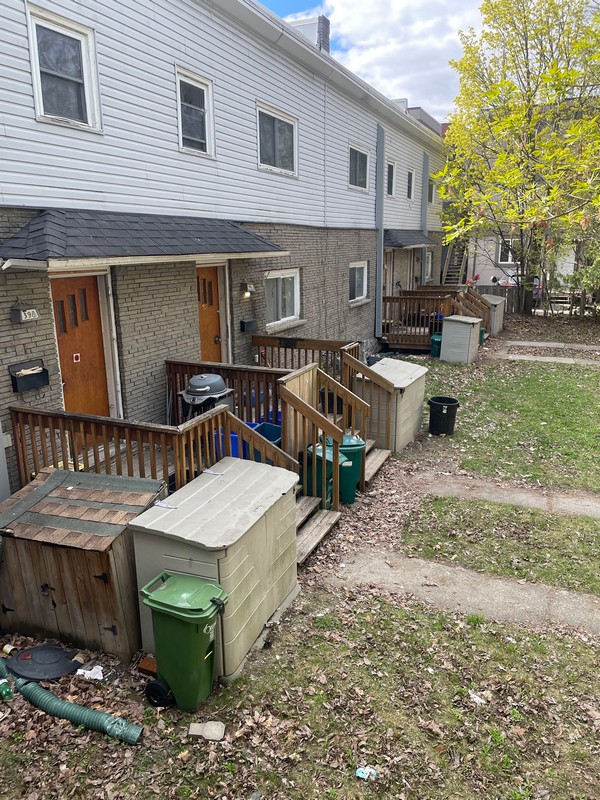
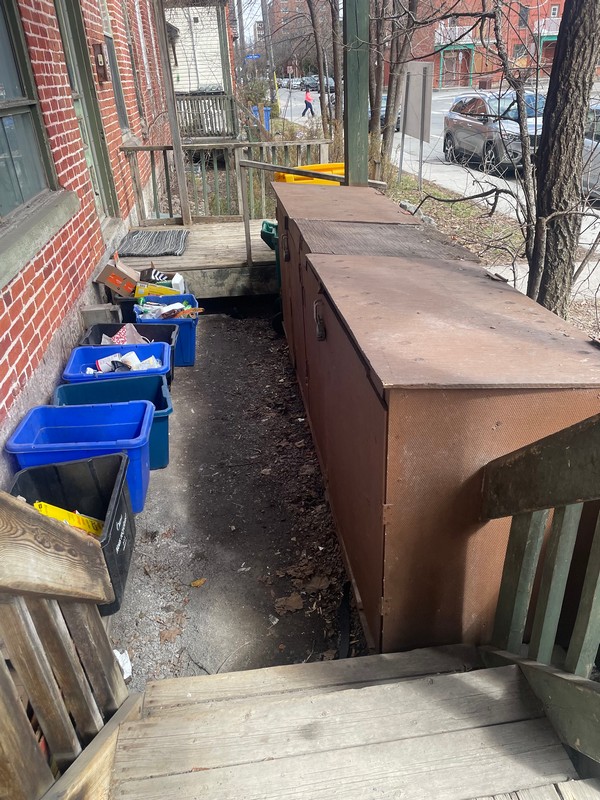
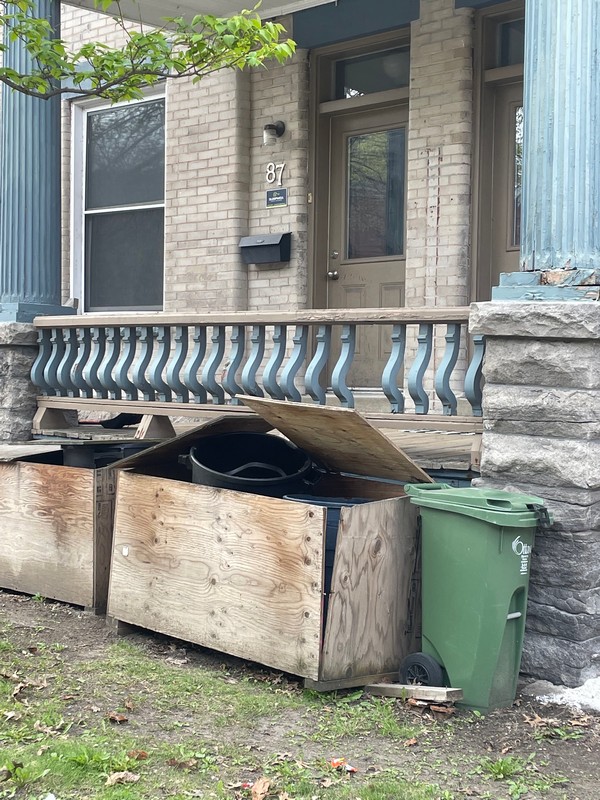
It is easy to see that at least two of the containers pictured are not constructed to prevent the entry of rodents or even a determined dog or cat. They do not have a tight fitting lid, nor are they kept neat. And yet, City bylaw officers must go by similar garbage containers every day without once filing a complaint.
But what would the complaint be based on? If the container were neat and had a tight fitting lid would everything be okay?
NO! Because there is absolutely no provision which allows garbage to be stored in the front yard, no matter how pretty the container, no matter how tight the container lid, and no matter how clean.
The bylaw does not say that a property owner can store their garbage in their front yard as long as it is stored in a clean, neat and tightly closed container.
The examples in the top and left photos feature various takes on the plywood box theme. But there are other variations.
In the example to the right, each of the four units is provided with a plastic garbage storage container. For a while, they do look better than the plywood variation; they generally have a tight lid. However, with time and rough usage, they tend to fall into disrepair and are often left in that condition.
But once again, the salient issue here is that these containers are placed in the front yard, a location not allowed by Ottawa bylaws. Yet nothing is done about it, even though the problem is staring the bylaw officers in the face. How do we explain this?
Aubry’s article quoted the City’s Director of By-law and Regulatory Services Roger Chapman: “We recognize that waste storage can sometimes be a challenge, and our goal is to keep our community clear and welcoming, while also working with the unique circumstances of each property. …BLRS will work with property owners to achieve compliance.”
But what does Chapman mean by compliance? Does he mean strict compliance with the bylaws concerning garbage storage? Or does he mean that, if necessary, he will bend over backwards to find the easy way out for a landlord who, perhaps, owns multiple buildings where, in his judgment, “waste storage can be a challenge”? Given the current situation in Sandy Hill, the answer to this question seems clear. I hope I am wrong.
In the next issue of IMAGE, I will address another specific example of the City’s failure to enforce its own waste management bylaws.