Sandy Hill residents share concerns about zoning changes coming to Somerset Street
Andrew Johnston
To plan for a more than 25 percent increase in population, City Council adopted a new Official Plan in 2022 that outlined the need for densification rather than sprawl and the creation of “fifteen-minute neighbourhoods.”
At the end of January, City Council passed a new zoning bylaw that would implement this plan. Under this new zoning bylaw, Somerset Street East will be designated a minor corridor, which could result in future redevelopment, leading to taller buildings, higher density, more traffic, and less greenery. This is the same zoning designation as wider, busier, and more densely built Laurier Avenue East.
Action Sandy Hill requested the removal of the minor corridor designation for Somerset Street East. Councillor Stéphanie Plante presented a motion to this effect, but it was narrowly defeated.
The period to appeal the new bylaw is from mid-March to late April. ASH is considering possible next steps. Below, three longtime Sandy Hill residents and community volunteers voice their concerns about the impacts this zoning change could have on our neighbourhood.
Concern for safety as much as density
Marilyn Whitaker, ASH Board member, raises safety concerns. Since the Adàwe Crossing opened ten years ago, Somerset Street East has been an important link for cyclists and pedestrians traveling from east of the Rideau River to the downtown core and further west. “People knew then that Somerset was narrow for cyclists, buses and other vehicles to pass safely, let alone have parking for the residences and businesses along the street,” recalls Marilyn. The curb-to-curb width of Somerset Street at Blackburn Avenue is 9.5 metres. The Transportation Association of Canada design guide specifies a minimum width of 11.7 metres for this situation. “Somerset East as a minor corridor encourages more dense construction and generates more traffic, making an existing hazardous situation worse,” notes Marilyn.
Well-being should be part of planning
“As we rebuild our city, we must do it with increased human well-being as our goal. Increased housing supply is one part of this, but so is creating healthy, well-treed neighbourhoods where people will thrive,” states Bryan Dewalt, co-chair of ASH’s Environment Committee.
The secondary plan within the Official Plan calls for a minor corridor along Somerset Street East. However, the 2022 plan envisioned a maximum building height of four storeys and non-residential land uses limited to “micro-retail and small-scale, locally oriented commercial use.” The recent zoning bylaw has inflated these minor corridor provisions for Somerset Street East to a maximum building height of 20 to 30 metres (about six to nine storeys) and a much wider range of commercial uses.
“I am particularly concerned about the future of the tree canopy along Somerset Street East,” Bryan continues. The minor corridor zoning for Somerset Street East will not require a minimum front yard setback for new developments. Any existing trees in the former front yard will be lost, and any new trees have a poor chance of surviving to maturity on the narrow public right-of-way between the sidewalk and the property line.
Why be concerned about trees? “The human health benefits of the urban forest are well established and accepted by the City itself in its Urban Forest Management Plan,” replies Bryan. “Trees filter air pollutants, mitigate noise, and do a lot to temper urban heating arising from climate change and our heat-trapping built environment. We should plan for the renewal of our urban forest and plan for growth with increased human well-being as our goal.
Increased housing supply is one part of this, but so is creating healthy, well-treed neighbourhoods where people will thrive.
— Bryan Dewalt, ASH Environment Committee
Eroding housing options
Cathy Major, longtime resident of Sandy Hill, has seen many changes in our community but fears this is the straw that breaks the camel’s back. “I agree with the emphasis in the Official Plan on providing housing for all and having walkable neighbourhoods. But this zoning change actually threatens the neighbourhood we already enjoy along Somerset and in Sandy Hill.”
Cathy notes that, currently, along the street, there is a mix of detached homes, two-storey row houses, and low-rise apartments, some with commercial entities. She fears that the minor corridor designation and extending building height to six and possibly nine storeys will only further erode housing options that are suitable for families, young couples, empty nesters, etc. Such a loss affects not only the street but the whole community. Sandy Hill has been undergoing densification for many years, and much of it is already a fifteen-minute neighbourhood.
For all of these reasons, we feel that Somerset Street East should not be designated a minor corridor. Stay tuned.
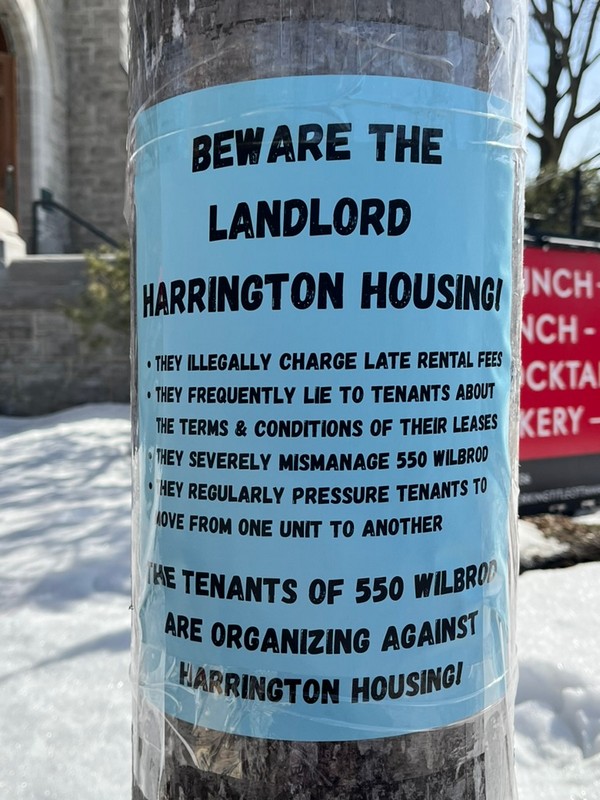
Photo: Christine Aubry
Tenants around Sandy Hill are continuing to organize and protest, as reported by Ethan Hill in the April 2025 issue of IMAGE (online at: www.home.imagesandyhill.org). IMAGE would love to hear from you if you are impacted. editor@imagesandyhill.org