Years of Collecting Art: The Bill Staubi Collection at the OAG
Maureen Korp
Grotto: The Bill Staubi Collection, curated by Sam Loewen and Caro Stewart, presents the work of 27 Ottawa artists, work arising from within Ottawa’s multicultural, queer community. It is a big, important show for the Ottawa Art Gallery.
Entering the exhibition on the fourth floor of the OAG, we are greeted by the voice of Bill Staubi coming from Rainbow Flag, in the corner on the right. Save that filmed interview for later. Start with the section called “Flagging,” off to the left at the back. Its large stained glass window depicting Jeanne d’Arc on horseback overlooks Ottawa.
Why is that window here? In this exhibition?
One hundred years ago, Jeanne d’Arc was a window in the convent wall of Ottawa’s Sisters of the Institute Jeanne d’Arc. Today, the convent is no more. Its window, however, was saved. Bill Staubi took it home. Really? Why not?
Jeanne d’Arc is a saint embraced by the queer community, one of several saints so honoured, among them John the Evangelist, Aelrod, and Sebastian. Said Pope Francis notably, in 2013, “Who am I to judge?”
The Jeanne d’Arc window in “Flagging” is centred in an area of signage display. In Handkerchiefs [A-D], 2021, by Kent Monkman, for example, a set of four cotton handkerchiefs, when seen at a distance, appear to be bullets, four large, upright bullets. Seen close at hand, however, “bullets” become “prayers,” hands folded in prayer. Praying for whom? Small beavers, beavers with wings, rear on the handkerchief edges. Do beavers go to heaven, too?
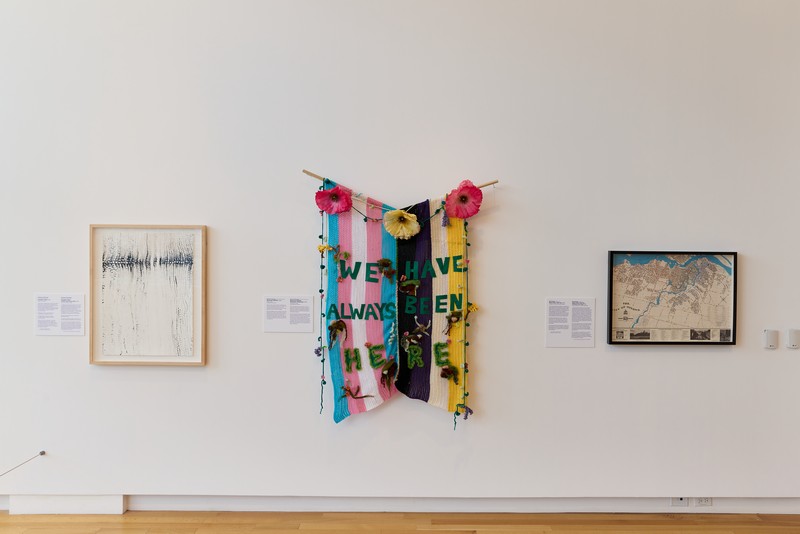
Saivani Sanassy’s tapestry Blooming Together, 2024, hangs nearby. It proclaims: “WE HAVE ALWAYS BEEN HERE.” Look at its flowers and attached elfin stuffies. Nothing scary here. Look at the quietude of Consider it Said, 2015, a work by Christos Pantieras—all done, peacefully.
Are there naked bodies to be seen in Grotto? Yes. Here, there, and underway. Inside an adjacent room of “Body Talk” work, two thoughtful paintings by Claude Marquis are paired. The top one, Man, 1998, is blue-ish in tone; the bottom one, Devil, 1998, is rosy. In both, we see the same figure—a naked dead man lying sideways, emasculated. The afterlife is “after” life, after all.
In the centre of the largest area of the exhibition stands a tall column topped with a black crow, Eve’s Rib, 2017, a sculpture by Anna Williams. The big bird holds a thin curved something in its beak. More thin, curved shapes are scattered at the column’s base. Do you know this story? The Genesis account?
The story of Adam and Eve is not set in stone. There are other tales, too. The Kiowa have a story that Crow turned black after eating the Snake. Was this the snake that tempted Eve? Whatever happened to Lilith? Ron Bergeron might have known.
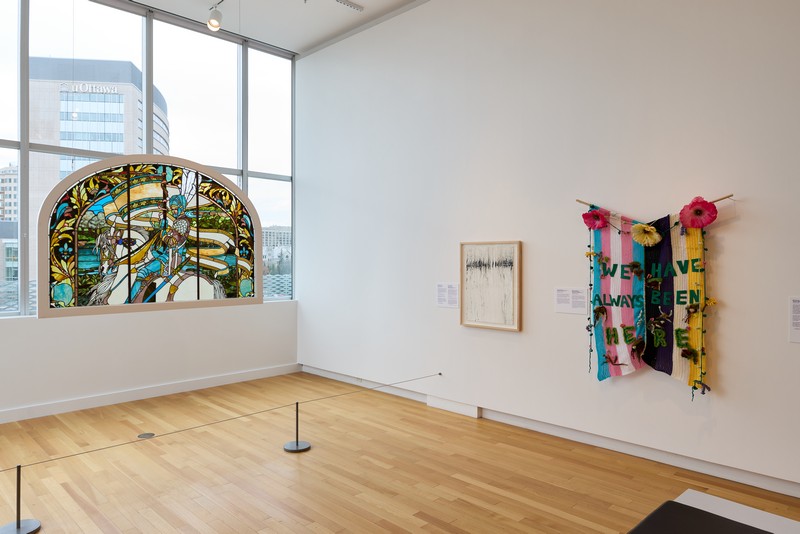
Photo: Rémi Thériault
Ron Bergeron was the first pastor of Ottawa’s Metropolitan Community Church, a church of particular outreach to Ottawa’s queer community. In 1984, Evergon photographed the pastor in profile, holding two magpies, as we see in Untitled Portrait of Ron Bergeron, 1984. Why magpies? Folklore tells us one magpie means death—ah, but two are mirth. The lesson here? Laugh, be happy. Ron Bergeron (1941-1990) died of AIDS.
The historical backdrop of colonialism with its Christian missionaries in the “New World” frames a goodly lot of the artists’ work throughout Grotto. Kent Monkman uses the persona of Chief Miss Eagle Testickle in his work with historical referents as we see in Resilience Plate, 2018. The Treaty of 1869, 2016, presents another possibility, too, in its depiction of the kneeling soldier and the chief in full regalia.
Along the wall is a bookshelf filled with a good many studies of colonialism and culture for visitors to peruse. The curators have done their work well. What happens next? An activity booklet for all ages includes simple questions. What do you know of it all? What do you know of yourself? More to say? Walk into the “Confessional,” an anteroom to the exhibition. Here, your comments may be left safely and anonymously.
Grotto is named for another “grotto,” the one inside Bill Staubi’s home—a small room, filled with icons, collected over many years. Near the exhibition’s Rainbow Flag is a little shrine Staubi himself fashioned: A Piece of Cake, 2017. Its angels hold high a beautiful cake, untouched by the devil below. Cherubs watch overhead, whispering secrets.
The OAG exhibition celebrates Bill Staubi’s acumen as a collector. More of the Staubi collection is currently at the Mississippi Valley Textile Museum in nearby Almonte. Check it out: https://mvtm.ca/art-from-the-collection-of-bill-staubi/
This is work Staubi donated to MVTM for fundraising. An artist’s work enters into the lives of others when it is seen, recognized, embraced. You, too, can collect art. The arts are here, all around.
Grotto: the Bill Staubi Collection continues until February 8, 2026 at the Ottawa Art Gallery, 10 Daly Avenue.
Reprinted with permission from The OSCAR (September 2025 issue)